About
St. Ann's Parish
The first St. Ann’s Church was financed by three parishioners who signed a note for $3,000. The church was built of brick on the site now occupied by the Heisey Center. The first resident pastor was Father Dols who was also responsible for parishes in Cascade, Choteau and Neihart.
Our History
From Parish Church to Cathedral
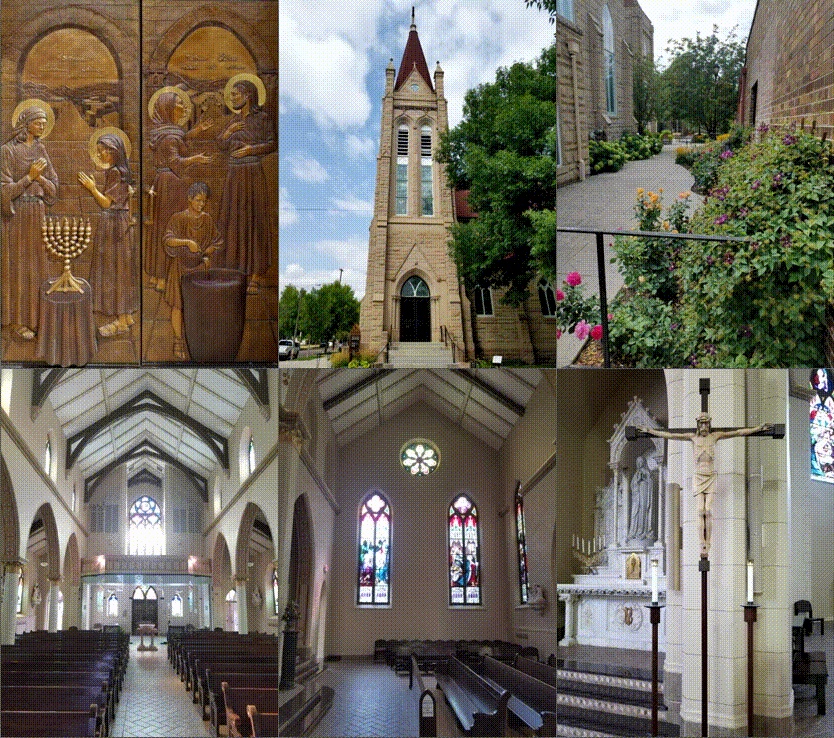
The story of St. Ann’s Cathedral is closely woven into the history of the Catholic Church in Great Falls. On May 18, 1904, Pope St. Pius X established the Diocese of Great Falls, and St. Ann’s was designated as its cathedral. As the Catholic community continued to grow, the diocese’s first bishop, Bishop Mathias Clement Lenihan, recognized the need for a larger church. Montana architect John H. Kent of Helena was chosen to design the new cathedral.
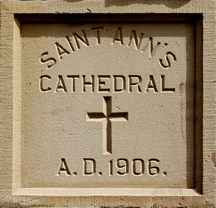
Construction of the present St. Ann’s Cathedral took place between 1906 and 1907 at a cost of approximately $100,000. Built of stone quarried near Stockett, the impressive Gothic Revival church features a cruciform floor plan, pointed Gothic arches, beautiful windows, and a prominent turreted bell tower. The former St. Ann’s church was then remodeled for use as a parish school.
A Growing Cathedral Campus
As St. Ann’s continued to serve a growing parish and diocese, its campus developed along with it. The present Rectory was constructed in 1931, with architectural elements chosen to complement the Cathedral.
In 1936, the former church building was demolished and the Heisey Youth Center was constructed on the site. Over the years, the building has also served as an important gathering and parish center. The Cathedral itself underwent an extensive renovation in 1953, as the Diocese prepared to celebrate its Golden Jubilee the following year.
St. Ann’s Becomes a Co-Cathedral
Another important chapter began on February 14, 1980, when Pope St. John Paul II renamed the diocese the Diocese of Great Falls-Billings. St. Patrick’s Church in Billings became a co-cathedral, joining St. Ann’s in serving the Catholics of the diocese.
In 1991, St. Ann’s Cathedral was recognized for its architectural and historical significance when it was included on the National Register of Historic Places as part of the Great Falls North Side Residential Historic District.
Preserving a Sacred Treasure
A major $2.1 million restoration was completed in 2003. The project repaired the Cathedral’s 21 stained-glass windows and restored important Neo-Gothic features that had been altered or concealed during earlier renovations.
The restoration helped preserve not simply a historic building, but a sacred place that generations of Catholics have called home—a church where countless Baptisms, First Communions, Confirmations, weddings, ordinations, funerals, and celebrations of the Mass have marked the lives of the faithful.
The Cathedral Organ
Music has long been an important part of worship at St. Ann’s. The Cathedral's impressive pipe organ was built in 1929 by the Reuter Organ Company. In 1995, the instrument was carefully restored and updated. The work enhanced its musical capabilities while preserving the historic character of an instrument that has accompanied generations of worshippers in prayer and song.
The Stations of the Cross
Along the walls of St. Ann’s Cathedral nave are the traditional 14 Stations of the Cross, offering parishioners and visitors a meaningful way to prayerfully walk with Christ from His condemnation before Pontius Pilate to His burial in the tomb.
The Stations were imported from Italy in 1906 and cost $300 at the time—approximately $11,166 in today’s dollars. They were generously gifted to the Cathedral by one of St. Ann’s parishioners.
Surrounded by the Cathedral’s beautiful stained-glass windows, detailed woodwork, and Gothic Revival architecture, the Stations are an integral part of the sanctuary’s sacred beauty. Together, the architecture and sacred artwork create a peaceful and inspiring setting where all who enter can pause, pray, and reflect on Christ’s Passion and His great love for us.
A Living Legacy of Faith
For more than a century, St. Ann’s Cathedral has stood at the heart of Catholic life in Great Falls. Its stone walls and stained-glass windows tell an important story, but the Cathedral's true history is found in the generations of people who have gathered here to worship, celebrate, mourn, serve, and grow in faith.
Today, St. Ann’s remains both a treasured historic landmark and, more importantly, a living house of worship—continuing the mission begun by those who came before us and welcoming generations yet to come.